
The Politics of Graphic T Shirts as Wearable Billboards
A graphic T shirt starts talking before its wearer says a word.
Across a sidewalk, at a concert, in a grocery line, or on a college quad, the message lands fast. A slogan. A symbol. A joke. A flag. A face. A phrase only some people recognize. The shirt does what a billboard does, but at human scale. It moves through public space. It invites approval, friction, curiosity, or silence.
That is why the politics of graphic T shirts are bigger than fashion. They sit somewhere between bumper stickers, protest signs, uniforms, and personal calling cards. A shirt can signal values, identify a community, challenge authority, soften a hard issue with humor, or turn the body into a walking argument.
And unlike a sign held at a rally, a shirt travels into ordinary life. It enters diners, airports, classrooms, parks, bars, and family cookouts. That everyday visibility gives it power.

Graphic T Shirts turn the body into public space
A billboard buys attention from drivers. A bumper sticker tags a car with a point of view. A graphic T shirt does something stranger. It attaches the message to a person.
That changes the meaning.
A slogan on a wall can feel anonymous. A slogan on a shirt has a face, posture, age, mood, and context. The wearer becomes part of the message, whether they mean to or not. The same phrase reads differently on a teenager at a march, a parent at a school board meeting, a musician on stage, or a retiree waiting at the DMV.
This is the core tension in wearable politics. A shirt is both casual and loaded. It can say, “I just threw this on,” while also saying, “Here is where I stand.”
That mix gives graphic T shirts as wearable billboards their unusual force. They make politics feel personal, visible, and portable. They also make the wearer available for interpretation.
A shirt might communicate:
A political belief
A cultural identity
A moral stance
A local concern
A joke with a sharp edge
A memory of a protest, campaign, or tragedy
A refusal to stay neutral
Even silence can become part of the message. A plain shirt in a room full of slogans can read as restraint. A loud shirt in a quiet space can feel like a challenge.
Unlike many forms of political speech, the T shirt lives close to the skin. It is intimate, but public. Soft, but confrontational. Disposable, but sometimes treasured for decades.
That contradiction is what makes it culturally durable.
The shirt works because people read clothes quickly
People are fluent in clothing. They may not think of it that way, but they read style constantly.
Work boots, band tees, sports jerseys, military jackets, denim vests, church clothes, black hoodies, handmade patches, thrifted sweatshirts, and campaign shirts all carry meaning. Some meanings are broad. Some are highly coded. Some change depending on the neighborhood, event, or generation reading them.
Graphic T shirts compress that language into a fast signal. The design has only a few seconds to work. That pressure shapes the form.
Strong political shirts usually rely on one of four tools.
Plain text
A direct phrase has the speed of a chant. Short words work best because they can be read in motion. “Vote,” “No war,” “Protect kids,” “Union strong,” or “Care for each other” do not ask for much time.
Symbols
A raised fist, a dove, a broken chain, a ballot box, a pink triangle, a peace sign, or a local landmark can carry history without a full sentence. Symbols reward people who recognize them. They also create distance from people who do not.
Humor
A funny shirt lowers defenses. It can make a political point feel less like a lecture and more like a wink. Satire has always belonged on cotton because shirts travel through mixed company. Humor lets the wearer test the room.
Belonging
Some shirts do not argue as much as they gather. A community event shirt, a mutual aid shirt, a Pride shirt, a labor shirt, or a neighborhood defense shirt says, “I stand with these people.” The politics are in the connection.

Design matters because attention is brief. A shirt that tries to say everything often says nothing. The most memorable ones leave space for the viewer to finish the thought.
That is why a good political shirt behaves more like a poster than an essay. It points. It frames. It provokes. It does not explain the entire platform.
A wearable billboard can build community or create conflict
Political clothing carries risk because it brings public speech into private-feeling places.
A bumper sticker stays with the car. A yard sign stays in the yard. A graphic T shirt walks into shared spaces where people may not be expecting a political exchange. That can create connection. It can also create tension.
Someone wearing a shirt with a local cause might meet a neighbor who wants to help. A union shirt might start a conversation with a worker in another field. A protest shirt might help strangers find one another in a crowd. In these moments, the shirt acts like a calling card. It makes recognition easier.
But the same visibility can invite confrontation. A shirt can anger people who disagree. It can be misread. It can reduce a complex person to one slogan in someone else’s eyes.
The wearer may want conversation, or they may not. The public does not always know the difference.
That uncertainty is part of the politics.
There is also the question of safety. Not every person can wear every message with the same freedom. Race, gender, age, disability, immigration status, religion, region, and local political climate all shape the risk. A shirt that feels playful in one neighborhood may feel dangerous in another. A slogan that gets applause at a concert may draw hostility at a gas station off the interstate.
So a graphic shirt is never just about the text printed on it. It is about the body that carries it and the place where it appears.
This is why political T shirts often become most visible at gatherings. Marches, concerts, fundraisers, vigils, festivals, and campus events create a shared frame. People expect messages there. The shirt joins a larger chorus.
In routine life, the shirt becomes more ambiguous. That ambiguity can be useful. It lets politics leak into spaces where speeches would feel out of place.
A person may not stop traffic with a shirt. But they may make one stranger feel less alone.
The best political shirts balance clarity and complexity
A graphic T shirt has limited real estate. That limit is not a weakness. It is the form.
The strongest designs know what they can do. They do not try to settle an argument in twelve inches of cotton. They open a door, mark a position, or create instant recognition.
A shirt that says “Vote” does not explain voter suppression, campaign finance, local ballot measures, or the Electoral College. It does not need to. The shirt’s job is to keep civic action visible in daily life.
A shirt supporting a strike does not describe bargaining demands in detail. It shows solidarity. It lets workers see support in public. It reminds everyone else that the conflict exists.
A shirt honoring a lost life does not replace grief, policy, or justice. It carries memory into public view. Sometimes that act matters because forgetting is political too.
The best shirts often share a few traits:
They can be read from several feet away
They avoid clutter
They use contrast well
They understand the audience without pandering
They feel wearable, not just clever on a screen
They leave room for the person wearing them
That last point matters. A political shirt should not swallow the wearer. If the message turns a person into a prop, the design has failed. At its best, the shirt extends something real about the person wearing it.
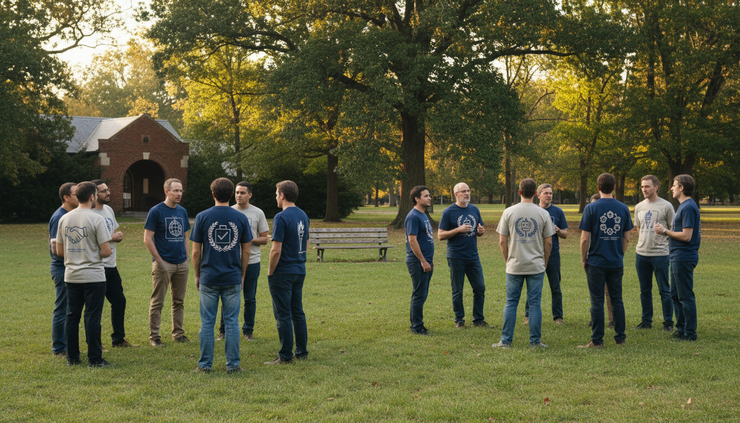
The complicated part is that clarity can slide into oversimplification. Politics reduced to merch can become shallow. A shirt can turn a crisis into an aesthetic. It can make belief feel like consumption. Buying the shirt can feel like doing the work.
That critique is fair. Clothing is not a substitute for voting, organizing, donating, volunteering, caring for neighbors, or showing up when attention fades.
But it is also too easy to dismiss the shirt as empty. Visual culture shapes public life. People carry signs because images matter. They wear buttons because symbols matter. They put stickers on laptops and water bottles because small declarations help map social worlds.
The problem is not political clothing. The problem is stopping there.
A shirt can be a starting point. It can make a cause visible, raise funds, identify allies, or keep a phrase alive. It becomes hollow only when the performance replaces the practice.
The graphic T shirt sits at the edge of protest and commerce
There is a reason political shirts often feel both sincere and commercial. They are objects for sale. Even when the cause is real, the cotton has a supply chain, a price tag, a printer, and a buyer.
That does not make the shirt fake. It does mean production choices carry meaning too.
A cheap shirt with a justice slogan can raise uncomfortable questions if the labor behind it is hidden or exploitative. A shirt about climate action can feel contradictory if it is treated as disposable. A campaign shirt can become landfill as soon as the election ends.
This is where the politics move beyond the print.
The message on the front matters. So do the conditions behind the garment, how long it lasts, who benefits from the sale, and whether the wearer treats it as a trend or a commitment.
None of this requires perfection. Most people make clothing choices under budget limits, time pressure, and imperfect information. Still, the gap between message and material is part of the story.
A more thoughtful political shirt culture might value:
Durable shirts people keep
Local printers when possible
Clear fundraising claims
Designs that age beyond one moment
Secondhand and reused garments
Messages tied to active work, not just mood
Some of the most powerful political shirts are not new at all. They are worn thin. The collar curls. The ink cracks. The date on the back marks an old march, a strike, a benefit show, or a campaign that only locals remember.
Those shirts carry history in a way new merch cannot. They say the wearer has been somewhere. They turn memory into fabric.

What a shirt can and cannot say
A graphic T shirt is powerful because it is incomplete.
It cannot explain every policy detail. It cannot prove the wearer lives by the message. It cannot guarantee courage, kindness, or consistency. It cannot replace the slow work that real political life demands.
But it can do something many forms of speech cannot. It can make belief visible in ordinary time.
That matters.
Politics is not confined to campaigns, courtrooms, debates, and election nights. It shows up in who feels safe, who feels seen, whose grief counts, whose labor is respected, whose neighborhood gets protected, and whose rights are treated as negotiable. A shirt cannot solve those fights. It can mark where someone stands inside them.
The modern graphic T shirt is the new billboard, bumper sticker, and calling card because it lives where people live. It carries a message through the messy public square of everyday life. Sometimes it starts a conversation. Sometimes it draws a line. Sometimes it simply helps one person recognize another.
The takeaway is simple: wear the message with care. A shirt can speak loudly, but the life behind it has to answer.

Comments